Developing and Managing Impactful Key Performance Indicators
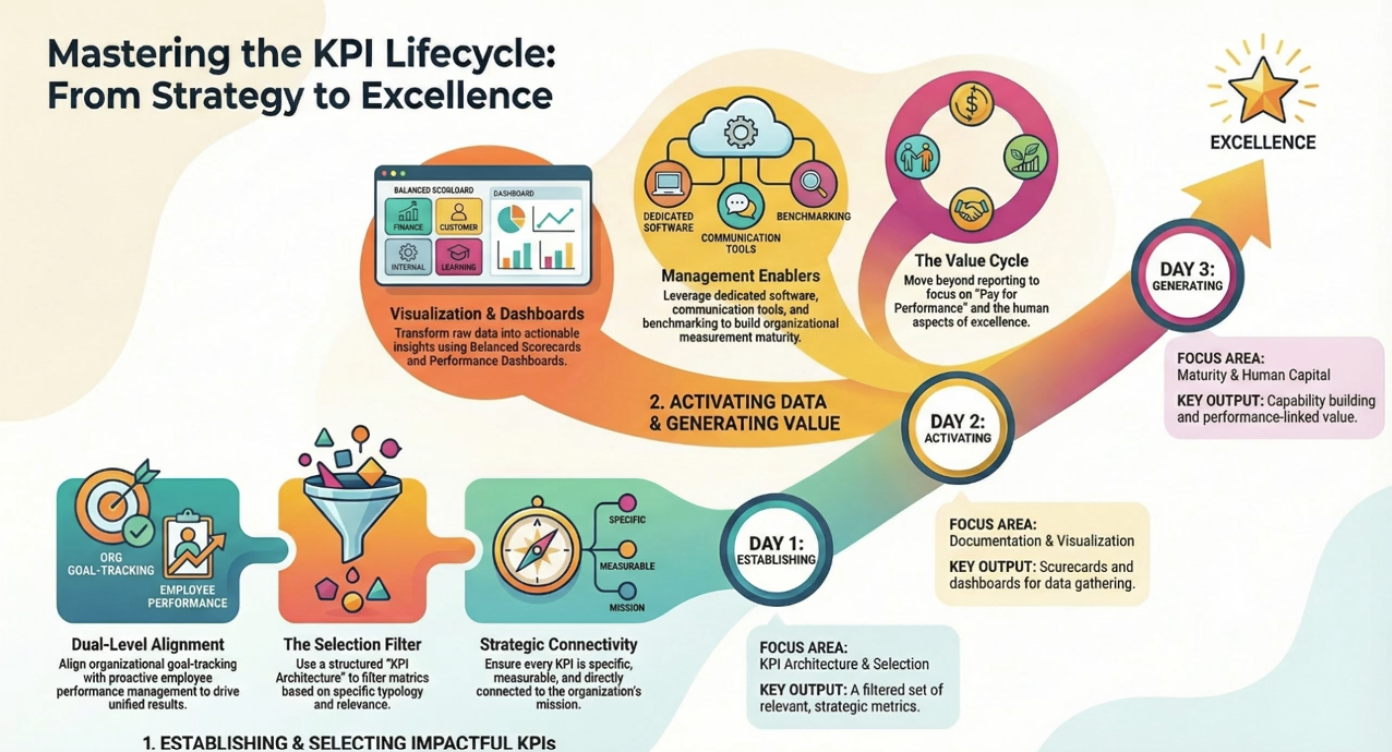
What this infographic shows
Every organisation aspires to achieve outstanding market performance. Performance management is both a strategy and an integrated approach to achieving organisational success by enhancing performance and developing the capabilities of teams and individuals. A successful organisation has a culture of establishing clear expectations for organisational performance and doing structured evaluations and monitoring to ensure that these objectives are satisfied. By integrating functional/departmental teams and individual employee achievements with the organisation's objective and vision, a performance management process provides the foundation for recognising excellence. Key Performance Indicators (KPIs) are applicable at both the individual and organisational levels. At the organisational level, a Key Performance Indicator (KPI) is a quantitative indicator that demonstrates how effectively a company is reaching its stated goals and objectives. At the employee level, KPI evaluations are a proactive technique for managing employee performance towards desired outcomes. For organisations to achieve outstanding performance, individual and corporate objectives must be aligned. Good key performance indicators are specific, measurable, connected with the organisation's goal, and support the development of strategies and plans. This two-day training session integrates balanced scorecard and performance management (KPIs) ideas, providing an understanding of strategy formulation, team/function objective development, and individual evaluation KPIs.



Want to explore this further?
This infographic highlights key insights connected to deeper learning and practical application. Discover programmes related to this topic or speak to us about how these insights can be applied in your organisation.
- ✔ Programmes aligned with this infographic
- ✔ Practical learning beyond the visual summary
- ✔ Facilitator-led and evidence-informed approaches
- ✔ Suitable for individuals & organisations