
Understanding and Managing Risk Attitude: Excellent People
Introduction
Risk management is recognised as an essential contributor to business and project success. It focuses on proactively addressing uncertainties to minimise threats, maximise opportunities, and optimise the achievement of objectives. Despite this vision, risk management often fails to meet expectations in practice, as demonstrated by the continued history of business and project failures. Foreseeable threats materialise into problems and crises, and achievable opportunities are missed leading to lost benefits. The mere existence of accepted principles, well-defined processes, and widespread practice is not sufficient to guarantee success. Some other essential ingredient is missing. The most significant Critical Success Factor for effective risk management is the one most often lacking: an appropriate and mature risk culture. Risk management is undertaken by people acting individually and in various groups. The human element introduces an additional layer of complexity into the risk process, with many influences, both explicit and covert. These lead to the adoption of risk attitudes that affect every aspect of risk management. Risk attitudes exist at individual, group, corporate and national levels. They can be assessed and described with some degree of accuracy, allowing sources of bias to be diagnosed, exposing their influence on the risk process.
Introduction
Programme Outline
What’s inside this outline?
This outline provides a structured overview of the programme’s objectives, key topics, and learning flow. It is intended to help you assess relevance and suitability before engaging further.
Resources
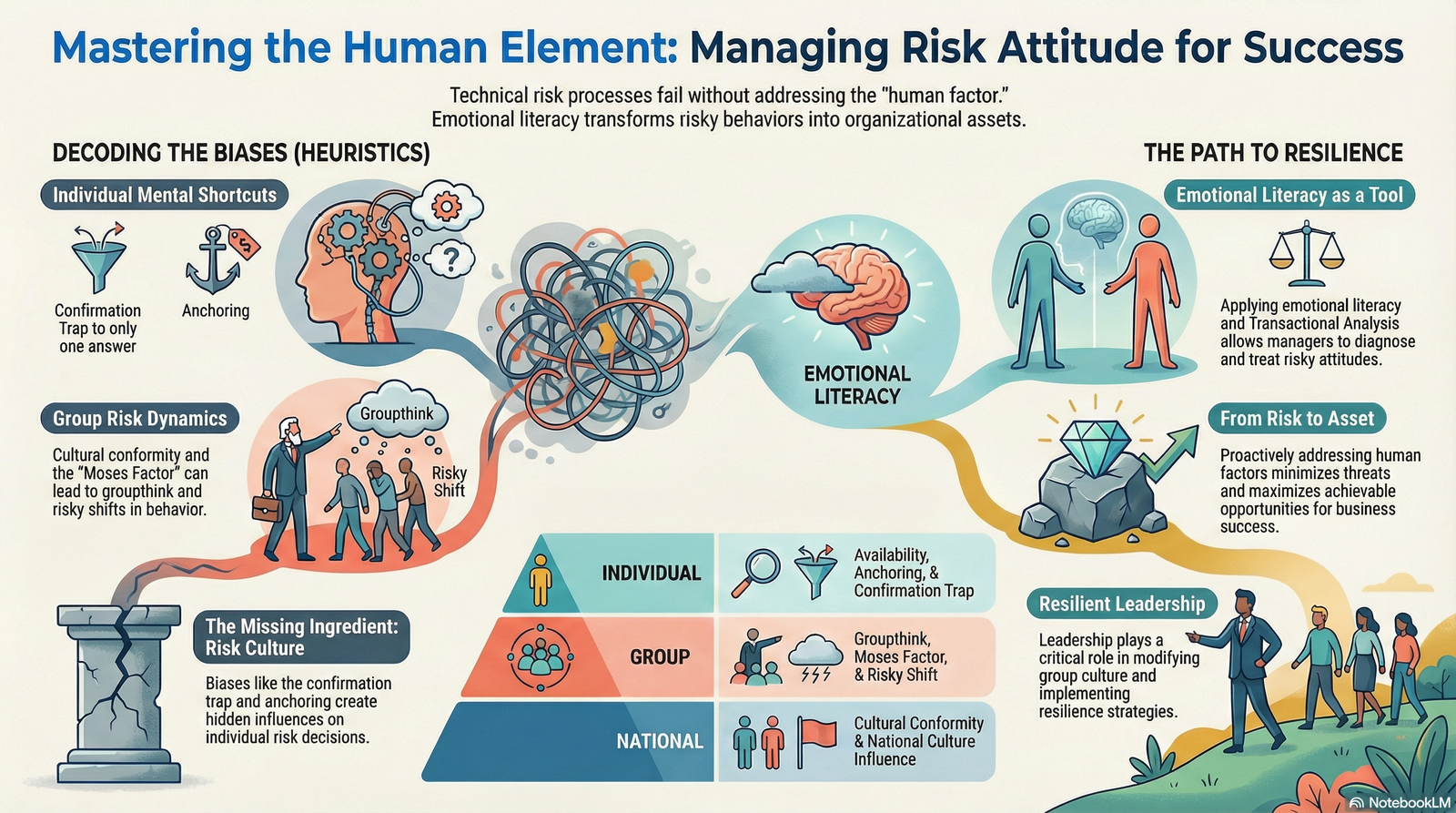
Managing Behaviour and Risk Attitude: Excellent People
Interested in this programme?
Explore how this programme and its related resources can support your learning goals, organisational needs, or professional development.
- ✔ Comprehensive programme content
- ✔ Supporting articles and infographics
- ✔ Practitioner-led insights
- ✔ Suitable for multiple learning contexts
Or email us at training@hba.com.my